Careers Academy
 The Careers Academy provides students with access to valuable resources to support their future career pathways. These resources include university and college prospectuses, apprenticeship information, and industry-specific materials. We offer career advice and personal support to all students, along with regular opportunities to engage with employers and participate in career-focused workshops.
You can also contact our careers team with any queries:
Careers Lead: Hayley Hayden, please click here to email
Careers Advisor: Wallis Day, please click here to email
The Careers Hub offers a well-organised, resource rich, welcoming environment where students can access impartial, high-quality information, advice and guidance. Open every day, the Hub supports students at every stage of their journey, helping them gain the knowledge, skills, and experiences necessary to make informed decisions about their future career paths.
Students can explore university and college prospectuses, apprenticeship information, industry-specific resources, and guidance on various career options. Each student has access to personalised career advice from our qualified advisors, and we host a wide range of activities throughout the year, including employer interactions, workshops, our annual Futures Fair, apprenticeship clinics, our fortnightly World of Work sessions, enrichment, our work experience programme, trips and events.
As a school, we are proud of our award winning careers team who meet all eight Gatsby Benchmarks, offering:
-
A stable and well-structured careers programme delivered through bi-weekly tutor sessions and embedded curriculum links. Unifrog access for all students
-
High-quality Labour Market Information through tutor activities and “Job of the Week” videos
-
Inclusive, data-driven support tailored to the needs of all students, including disadvantaged and SEND students
-
Teachers connect subject content to real-world pathways, including trips, careers talks and displays, linking curriculum learning to careers
-
Employer encounters such as our Futures Fair with 65+ exhibitors, World of Work Day and industry speakers
-
Experiences of workplaces, including 100% uptake in Year 10 and Year 12 work experience
-
Encounters with further and higher education, including visits to Goldsmiths University and workshops with Portsmouth and Southampton Universities and our Post-18 Pathways event
-
Personal guidance through one-to-one interviews
We are proud to offer full inclusion across our careers provision:
-
Disadvantaged students benefit from targeted programmes such as Zero Gravity and Future Frontiers, personalised coaching, employer visits, bursaries and school-sourced work experience
-
SEND students receive bespoke guidance, tailored work experience, transition planning and specialist programmes such as the Sixth Form Employability course, as well as enhanced support for EHCP students
Our careers programme is fully compliant with the Careers Guidance and Access for Education and Training Providers legislation, including the Provider Access Legislation (PAL). We ensure all students have access to independent, impartial guidance and a broad range of employer and provider engagement.
It is never too early to start thinking about your future. The decisions you make in Years 9, 11, 12, and 13 will shape the opportunities available to you later on.
Choosing to go to university is a significant decision. There is a lot to consider – what to study, the cost of a degree, whether to live at home or away.
At LPGS, every student has a UNIFROG account and students can utilise it to shortlist universities and courses. Students are encouraged to explore courses that are relevant to their subject choices throughout their time in KS4 and KS5
Beginning in the Summer term of Year 12, we run a comprehensive UCAS support programme.
Students are welcome to come to the LPGS Careers Hub to book meetings for assistance in shortlisting their universities and courses.
Funding your university course
University courses in the UK are primarily funded through government-backed student loans for tuition fees and living costs, with Tuition Fee Loans paid directly to the university and Maintenance Loans paid to you. Additional funding options include grants for those with specific needs, scholarships, bursaries and other forms of financial support. An application for Student Finance is typically made online through the government's website, and you must reapply each year of your course.
- Government Student Loans and Tuition Fee Loan: Cover the cost of the university course. It is paid directly to the university or college and graduates will start repaying it after the completion of their course and when their earnings exceed £26,900.
- Maintenance Loan: Helps with living costs such as rent, food and books. This is paid directly into a student’s bank account, usually at the start of each term.
How much will each student receive?
The amount depends on factors like household income, where a student resides and where they study.
Application: Students will apply during their time in Year 13 via the GOV.UK website.
Students may be entitled to apply for further grants, scholarships and bursaries. More information can be found here.
Useful Websites
The number of apprenticeships available in the UK is growing considerably year on year.
A summary of the levels of apprenticeships in the UK is below:
| Level | Type | Equivalent Qualification(s) | Key Features |
| 2 | Foundation/intermediate | GCSEs (grades 9-4A*-C) or NVQ Level 2 | Entry-level, building foundational job skills |
| 3 | Advanced | A-Levels, T-Levels or NVQ Level 3 | Develops more responsibility, equivalent to 2 A-Levels |
| 4 | Higher | HNC or first year of Bachelor's degree | Involves higher-level technical skills, often project management |
| 5 | Higher | Foundation degree or HND | Similar to Level 4 but can include people management |
| 6 | Degree | Bachelor's degree (BA/BEng/BSc) | Work towards a full university degree, complex projects |
| 7 | Degree | Master's degree (MA/MSc/PGDip) | Expert-level, post-graduate study, managing large teams or projects |
In an apprenticeship, an apprentice will typically work for 80% of the time and study for 20%.
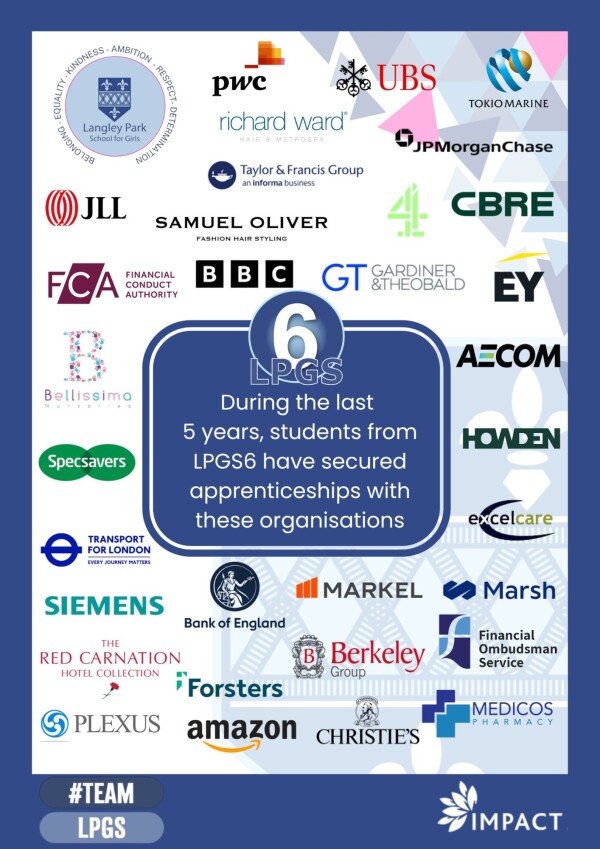
Post-16 Apprenticeships are available to students leaving full time education at age 16. Students are encouraged to make an appointment with the LPGS Careers team to discuss their options and receive support in the application process.
All students who have completed their A-Levels or equivalent, can apply to a degree apprenticeship. The number of degree apprenticeships has increased considerably in the last four years. Once a candidate has completed this level of apprenticeship, they will be awarded the same degree as somebody who has studied full time.
The main advantages of a degree apprenticeship are gaining valuable experience in the workplace, whilst being awarded a salary and having their tuition fees paid for by the company providing the apprenticeship.
Graduate Apprenticeships provide work-based learning opportunities for graduates to obtain a Master's degree. This apprenticeship works in a very similar way to a Degree Apprenticeship in that candidates work for 80% of the week and study for the remaining 20%.
Each apprenticeship vacancy will specify how you need to apply – applications are usually made direct to the employer — through an application form, or a CV and covering letter.
When to apply
Apprenticeship vacancies appear throughout the year – each will give a deadline for applications, and start dates.
Vacancies for degree apprenticeships (Level 6) with larger firms often start to be advertised from September. Smaller businesses, offering Level 3 apprenticeships, typically advertise a month or two before the apprenticeships start.
Students who are interested in applying for apprenticeships are encouraged to follow the “Early Careers” pages of the institutions they are interested in.
Useful websites
Years 7 and 8
It is never too early to start considering careers and what the journey of a young person could look like. That said, it is important not to worry about it, these should be exciting things to talk about and the future is an exciting place.
Maybe you could start focusing on 'skills'.
By skills, we often mean 'soft skills', ones that are not obviously being taught in lessons, but are used and built up during our lives. You can also refer to these as 'transferable skills'.
Examples:
-
Communication
-
Teamwork
-
Adaptability
-
Problem solving
-
Creativity
-
Work ethic
-
Interpersonal skills
-
Time management
Parents/carers might wish to discuss the following with their child:
What skills do they have? (none is not an answer!)
What skills do you think they have?
How would it be possible to prove and improve these skills?
What clubs do they attend? Guides, Scouts, music groups, sports clubs
What do they help with? Helping at home, supporting people, volunteering
When do they work outside their comfort zone with people or things that are challenging or that do not come naturally to them?
What could they get involved with at school? - taking a personal responsibility, standing for school council, helping a teacher, attending one of the many extra-curricular clubs or societies
Year 9
During this year, students will be making their GCSE options; the Guided Choices process begins in the Spring term. The school will give the students plenty of time to think about what choices they have and how these will impact upon their future opportunities. There will also be parents' evenings and information evenings where information will be shared with parents/carers and students.
Conversations at home about subject choices and which careers they can relate to are encouraged. Parent/carers can find information to support these conversations on this using their UNIFROG link.
The links below might also help with these conversations:
brightknowledge.org/education/gcses-explained
icould.com/stories/choosing-your-gcse-options-video/
icould.com/stories/tactics-for-making-decisions/
Years 10 and 11
Parents/carers can support their students in Years 10 and 11 by providing guidance and resources to help them explore their career options. Here are some ways parents/carers can assist their children in making informed career choices.
-
Encourage open discussion: Start conversations about career options and interests. Listen to their thoughts and feelings without judgement
-
Use assessments: Help students identify their skills and interests by using short assessments, we recommend the Buzz quiz
-
Explore options together: Together, students and parents/carers can explore various education and careers paths. This can lead to new ideas and a more comprehensive understanding of the options available
-
Access resources: Utilise online platforms, such as Unifrog, to research careers and subjects
-
Attend events: Participate in events such as careers fairs and mock interviews to gain practical experience and meet potential employers
Years 12 and 13
The following links are for useful websites and resources related to Post 16 options and Post 18 options, university, apprenticeships and careers.
nationalcareers.service.gov.uk
What is Labour Market Information (LMI)?
LMI effectively describes the world of work – it ranges from descriptions of different careers, their entry routes, promotional prospects, salaries paid, skills and qualifications needed.
Crucially for young people, LMI also covers future demand – what kinds of jobs will be in demand after leaving school and what skills will be needed.
Why is LMI Important to Our Students?
It is vital, in an environment where new industries are emerging and many of the most important jobs of the future don’t yet exist, that individuals have access to high-quality labour market information and earnings data to underpin their choices.
Anne Milton MP
Learning from Careers and Labour Market Information.
Understanding LMI is becoming increasingly important as the world changes. Students must be aware of growing industries and where there are skill gaps.
Below is information on what LMI actually means
-
What people actually do in this job or industry
-
How many people work in this job or industry
-
How much people get paid in this job or industry
-
What qualifications are required to undertake this job
-
The skills or qualities needed to do the job
-
Typical working hours
-
The percentage of men and women working in this industry or job
-
Where this job or industry can take you in the future
-
Job locations (places of work across the country)
-
The number of these jobs there will be in the future
Students can find all of this information on every job profile using their UNIFROG account.
Skillsometer – LMI For All
Skillsometer has been designed for those who are not sure what jobs they may be interested in. Thinking about skills, interests and the ways these can link to jobs can be a helpful first step in identifying possible future jobs.
The quiz requires you to reflect on a number statements and decide what you love, are not sure about or dislike. The statements are presented within six well established occupational categories (Artistic, Realistic, Investigative, Conventional, Enterprising, and Social), which are then ranked against jobs. Once you have completed the quiz you are given a short list of job suggestions that are most likely to be suited to your own particular skills and interests. Each job is described and is presented with information on pay and hours. For further information on the job, and to compare with other jobs, you could then go to the Careerometer below.
Careerometer – LMI For All (link)
Careerometer is an online data portal which connects and standardises existing sources of high quality, reliable LMI to support the process of identifying potential careers. It allows students to compare national average wages, working hours and future employment prospects.
How to use the Careerometer:
Simply type in the first career that you think you might be interested in and select from the drop down list, then add your second and third choices to see the comparison.
Our Careers Policy and Provider Access Policy are available on our Policies page here.
LinkedIn Safeguarding Guidance
Information on our Sixth Formers' Post 18 destinations can be found here.